Every enterprise now runs AI. The question is no longer whether to adopt it, but whether your adoption is actually working.
The numbers tell a sobering story. Over 80% of AI projects failed to reach production in 2025. Nearly two-thirds of organizations remain stuck in pilot purgatory. And 42% of companies abandoned most of their AI initiatives entirely — up from just 17% the year prior. Meanwhile, enterprise AI activity surged over 90% year-over-year, with employees deploying tools across departments, often without security guardrails or centralized oversight.
The result? A new kind of organizational chaos. Fragmented conversations scattered across a dozen AI tools. Institutional knowledge that evaporates the moment someone closes a tab. Shadow AI proliferating faster than shadow IT ever did. And CIOs left trying to govern an expanding army of agents, models, and copilots that don't talk to each other — and don't remember a thing.
The technology isn't the problem. The architecture is.
The Missing Layer
Think about how your organization actually uses AI today. Marketing has its content tools. Engineering runs code assistants. Sales leans on conversational AI. Finance uses forecasting models. Each tool is powerful in isolation. None of them share context.
Your company's institutional knowledge — the strategic decisions, customer relationships, market lessons, and operational wisdom accumulated over years — is scattered across emails, Slack threads, documents, and the minds of employees who might leave tomorrow. When someone asks an AI tool a question, that tool has zero awareness of any of this. It starts from scratch. Every. Single. Time.
This isn't an AI problem. It's an infrastructure problem. And it's why the next great enterprise technology category isn't another AI tool — it's the intelligence layer that sits beneath all of them.
Introducing the Enterprise AI Core
This is what Caura was built to be: the connective tissue between your teams and any AI. Not a replacement for your existing tools, but the orchestration layer that makes all of them dramatically more useful.
The architecture rests on four pillars — each addressing a fundamental gap in how enterprises deploy AI today.
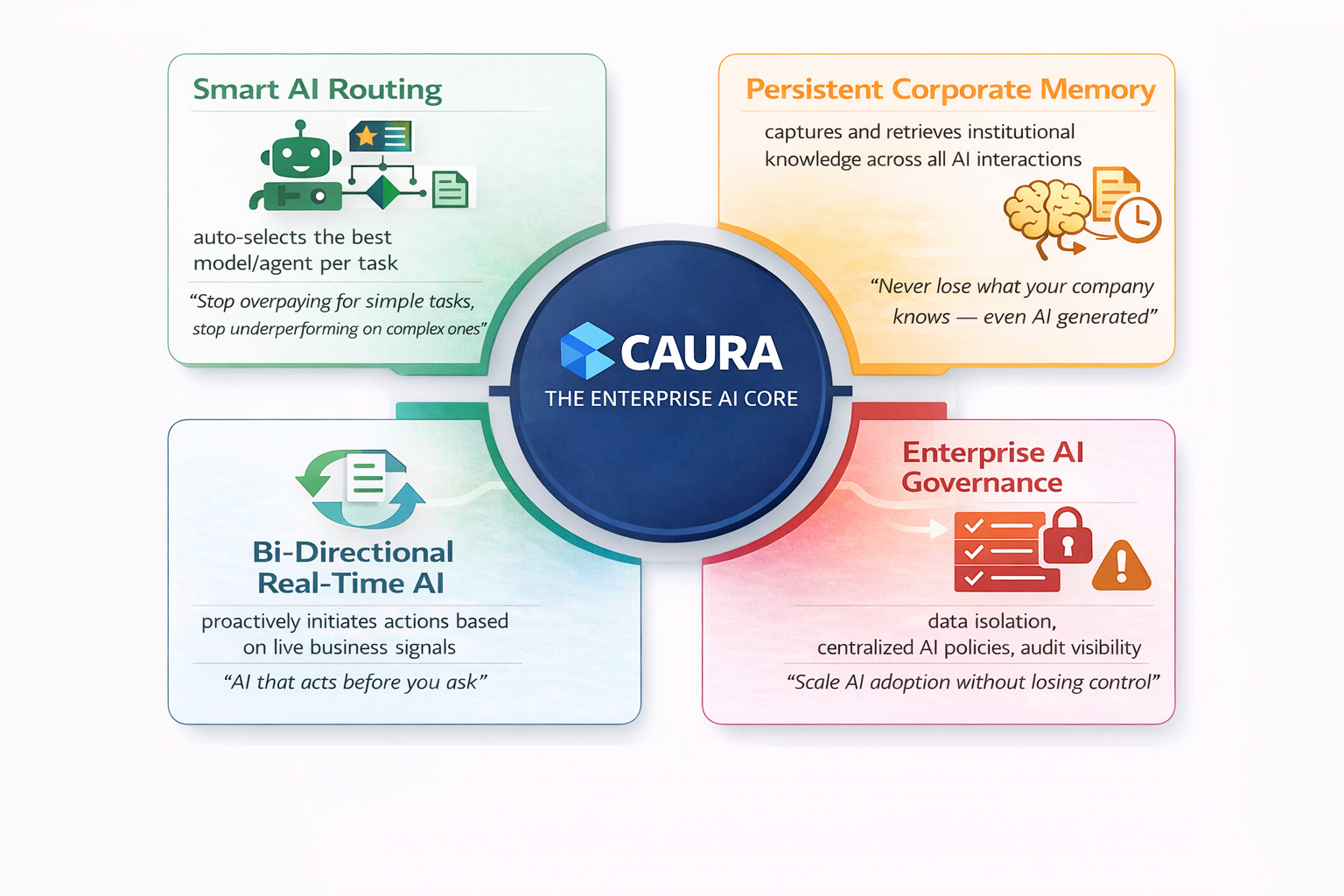
Smart AI Routing: Stop Overpaying for Simple Tasks. Stop Underperforming on Complex Ones.
Not every question requires the most powerful (and expensive) model. A quick summary doesn't need the same horsepower as a multi-step strategic analysis. Yet most enterprises either route everything through a single provider or leave the model selection up to individual employees — creating both cost bloat and inconsistent quality.
Caura's Smart AI Router automatically selects the optimal model or agent for each task. GPT, Claude, Gemini, open-source models — the router evaluates the request and matches it to the right intelligence. This does more than save money. It decouples your organization from any single AI vendor, eliminating lock-in while ensuring every task gets the right level of capability.
The practical impact: your finance team's routine data pulls don't burn premium tokens, while your strategy team's complex scenario analyses get the depth they demand. Every interaction is optimized by default.
Persistent Corporate Memory: Never Lose What Your Company Knows
Here's the uncomfortable truth about enterprise AI in 2026: every AI interaction your company has today is disposable. Close the chat, lose the context. Switch tools, start over. An employee spends 45 minutes working through a complex analysis with an AI assistant, and the moment they're done, that knowledge vanishes.
Now multiply that by hundreds or thousands of employees, across dozens of tools, over months and years. The knowledge loss is staggering — and invisible.
Caura's Persistent Corporate Memory layer captures and retrieves institutional knowledge across all AI interactions. Not just chat logs, but the semantic understanding of what your organization knows, how it thinks, and why it makes the decisions it does. This memory persists across sessions, across tools, and across team members.
When a new analyst asks an AI about your Q3 pricing strategy, the response is informed by every relevant conversation, decision, and data point your organization has generated — not just whatever the analyst remembers to paste into the prompt. Your AI finally has the context that makes it genuinely useful.
Bi-Directional Real-Time AI: AI That Acts Before You Ask
Traditional AI is reactive. You ask a question, you get an answer. But the most valuable intelligence isn't triggered by human queries — it's triggered by events.
Caura's bi-directional architecture doesn't just respond to your teams. It proactively initiates actions based on live business signals. A key account's sentiment shifts negative across multiple touchpoints? Caura surfaces it before your account manager notices. A regulatory change affects three active deals in your pipeline? Your legal and sales teams are alerted simultaneously, with context.
This transforms AI from a tool you use into a system that works alongside you — monitoring, connecting dots, and acting on patterns that humans would catch too late, or miss entirely.
Enterprise AI Governance: Scale Adoption Without Losing Control
Shadow AI has become the top visibility risk for enterprises in 2026. More than half of organizations encounter unsanctioned AI usage monthly, and the problem is accelerating. Employees deploy advanced models on sensitive company data without oversight. API keys and credentials flow through AI tools without audit trails. And compliance frameworks — from the EU AI Act to evolving state-level regulations — are expanding to cover AI decision-making transparency.
The enterprises that scale AI successfully aren't the ones moving fastest. They're the ones moving with control.
Caura provides centralized AI policies, complete audit trails, role-based access controls, and data isolation — all from a single governance layer. Every AI action across your organization is tracked, governed, and aligned with your company's policies. Your CISO gets full visibility. Your compliance team gets defensible audit trails. And your employees get the freedom to use AI without creating organizational risk.
Why This Matters Now
The enterprise AI landscape is at an inflection point. Industry analysts are projecting that enterprises will increase AI budgets in 2026, but concentrate spending on fewer, more capable platforms. The era of experimentation is ending. The era of consolidation is beginning.
Organizations that continue to deploy AI as a collection of disconnected point solutions will keep hitting the same walls: fragmented knowledge, redundant costs, ungovernable sprawl, and the persistent failure to move from pilot to production.
The enterprises that win will be the ones that invest in the layer beneath the tools — the intelligence infrastructure that turns isolated AI capabilities into unified organizational cognition.
Every company can access the same models. Most can collect the same data. But organizational memory — the accumulated context of how your company thinks, decides, and operates — is yours alone.
The enterprise that builds this intelligence layer first doesn't just get better AI. It gets a compounding advantage that grows with every decision, every interaction, every day.
The Bottom Line
You don't need another AI tool. You need the layer that makes all your AI tools intelligent.
Caura is that layer. Governed Shared Memory for AI Agents.
Ready to Build Your Intelligence Layer?
Join the enterprises that are turning AI chaos into competitive advantage.
Get Early Access