PeerRank · 8 frontier models graded each other
Meta’s Muse Debuts. Opus 5.5 Pulls Away.
Meta’s two Muse models sat their first PeerRank against six frontier models and landed mid-table, ahead of Grok. At the top, Claude Opus 5.5 widened its lead, and last week’s biases came back almost to the decimal.
Meta’s Muse Wonder 1.0 and Muse Spark 1.3 joined the panel this week and finished sixth and seventh, within a fifth of a point of Gemini and DeepSeek. Claude Opus 5.5 won again, and this time it wasn’t close. Every model still liked its own name. And none of them, judges included, could agree on what is happening in the world right now.
The numbers come from 11,137 peer scores in PeerRank run oct-13-26, the follow-up to last week’s run.
peer score
over #2
grading itself
question
debut score
The setup: eight models, 200 questions
The protocol is the same as last week. Every model played three roles: it wrote questions, it answered everyone’s questions, and it graded everyone’s answers.
- Ask. Each model wrote 25 questions, five in each category (creative, current events, factual, practical, reasoning), for 200 in total.
- Answer. All eight models answered all 200 questions. Current-events questions came with the same live web search results for every model.
- Judge. Each model scored every answer from 1 to 10, three separate times:
- Blind + shuffled: names hidden, order random. This is the fair baseline, called the peer score. A model’s grades for its own answers are left out of it.
- Names shown: order random, model names visible.
- Fixed order: names hidden, answers always in the same order.
Alongside Meta’s two Muse models, the panel kept last week’s six: Claude Opus 5.5, Claude Fable 5.1, GPT-6 Astra, Gemini 3.8 Flash, DeepSeek V4.1 Flash and Grok 4.7.
Opus 5.5 pulled away
Claude Opus 5.5 finished first with a peer score of 8.88, ahead of Claude Fable 5.1 (8.67) and GPT-6 Astra (8.65). It won 73.8% of its head-to-head comparisons, and its Elo of 1743 is 126 points clear of second place. Last week that lead was 53 points.
Final standings
Peer score from blind, shuffled grading, self-ratings excluded. Elo from 33,411 pairwise matches.
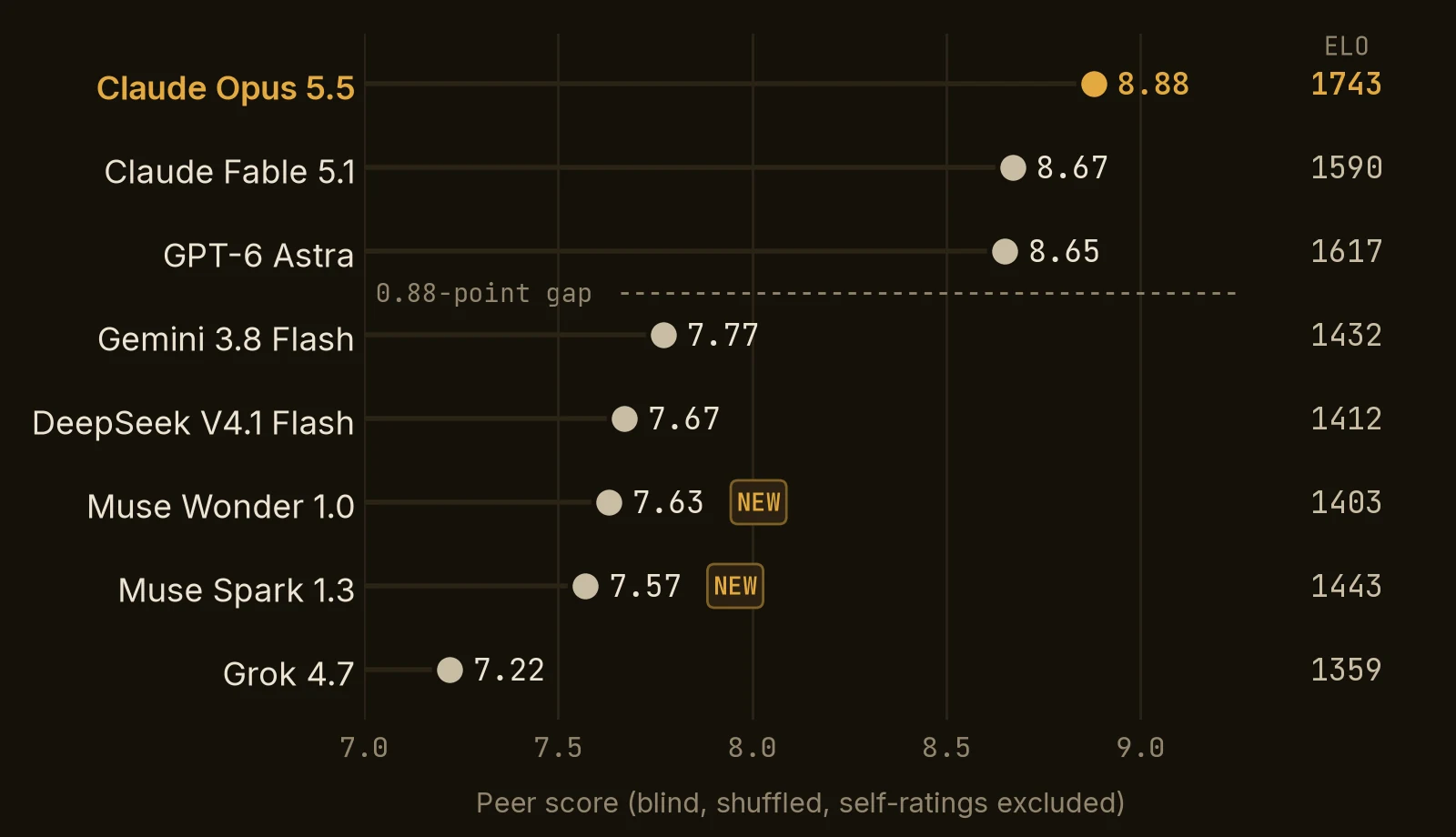
Then comes a cliff. The drop from third to fourth is 0.88 points, the biggest gap in the table. Below it, Gemini 3.8 Flash, DeepSeek V4.1 Flash and both Muse models sit within 0.20 points of each other, and Grok 4.7 is last at 7.22.
Elo agrees with the peer score at the top and the bottom and reshuffles the middle. It puts GPT-6 Astra second instead of third. When four models are within two tenths of a point, one run doesn’t settle their order.
Meta’s Muse: a mid-table debut
Muse Wonder 1.0 and Muse Spark 1.3 finished sixth and seventh on peer score, at 7.63 and 7.57. That puts them 1.0 to 1.3 points behind the two Claudes and GPT-6 Astra, ahead of Grok 4.7, and within 0.20 points of Gemini 3.8 Flash and DeepSeek V4.1 Flash. For a first run against this field, that’s a solid start rather than a breakthrough.
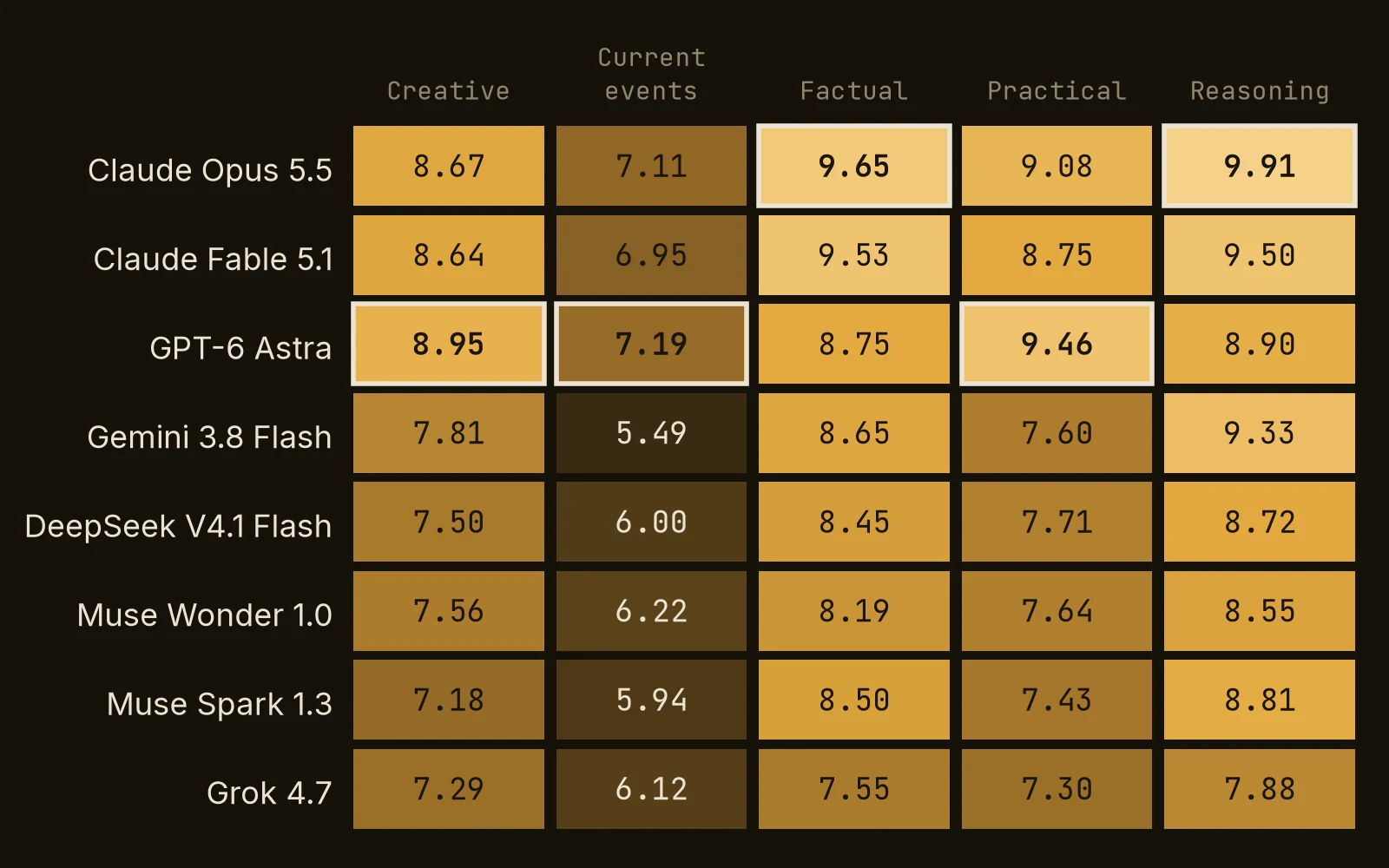
The two Muse models behaved very differently. Muse Wonder answered in 5.13 seconds, the second-fastest in the run. Muse Spark took 13.32 seconds, the slowest, and did its best work on closed-book questions: it finished fifth in both factual (8.50) and reasoning (8.81), two places above its overall rank. Elo, which counts head-to-head wins, ranks Muse Spark fourth (1443), even though it won only 38% of its matches.
As judges, they had their own habits. Muse Wonder was the most generous grader on the panel (an average of 8.29, tied with DeepSeek V4.1 Flash), and it did significantly better on questions it wrote itself (+0.36, p < 0.001). Muse Spark graded its own answers closer to its peers’ verdict than any other model did, just 0.06 points higher, and its grades tracked Grok 4.7’s more than any other judge’s (r = 0.77).
No model wins every category
Opus 5.5 led factual questions (9.65) and reasoning (9.91, the highest score in the run). GPT-6 Astra led creative (8.95), practical (9.46) and current events (7.19). Gemini 3.8 Flash was third in reasoning at 9.33 and last in current events at 5.49, a 3.84-point swing inside a single model.
Score by category
Peer score per model and question category. The best score in each column is outlined.
The news is still the hardest question
Current events was the lowest-scoring category for all eight models. All five of the hardest questions in the run were about the present:
Hardest questions
Average peer score for the answers, out of 10.
| Question about | Average |
|---|---|
| The top-grossing film at the global box office | 3.16 |
| The winner of the 2026 FIFA World Cup | 3.53 |
| The most recent Nobel Prize in Literature | 3.91 |
| The latest major climate agreement | 4.14 |
| The 2026 Nobel Prize in Physics | 4.16 |
The answering models got live search results. The judges got none: search was on for answering and off for grading. A judge without search can only check an answer about the present against what it remembers, and each judge remembers a different present. The most disputed question in the run asked who the UK’s current prime minister is. Its scores had a standard deviation of 3.53 points on a 10-point scale, the widest of any question.
For a chatbot, that’s a quirk. For a fleet of agents, it’s a design problem: one agent acts on a fact that another agent can’t check. Agents that work together need a shared record of what is true now, with a source and a date on every fact.
The biases came back, almost to the decimal
Last week’s run found three biases. All three showed up again.
Self bias. Seven of the eight models scored their own answers above what their peers gave them. GPT-6 Astra again inflated itself the most, by 0.66 points (0.76 last week), followed by DeepSeek V4.1 Flash at 0.46. Claude Opus 5.5 was the only model to grade itself lower than its peers did, by 0.12.
Self bias and name bonus
Self bias: a model’s score for its own answers minus its peer score. Name bonus: the score with model names shown minus the blind score.
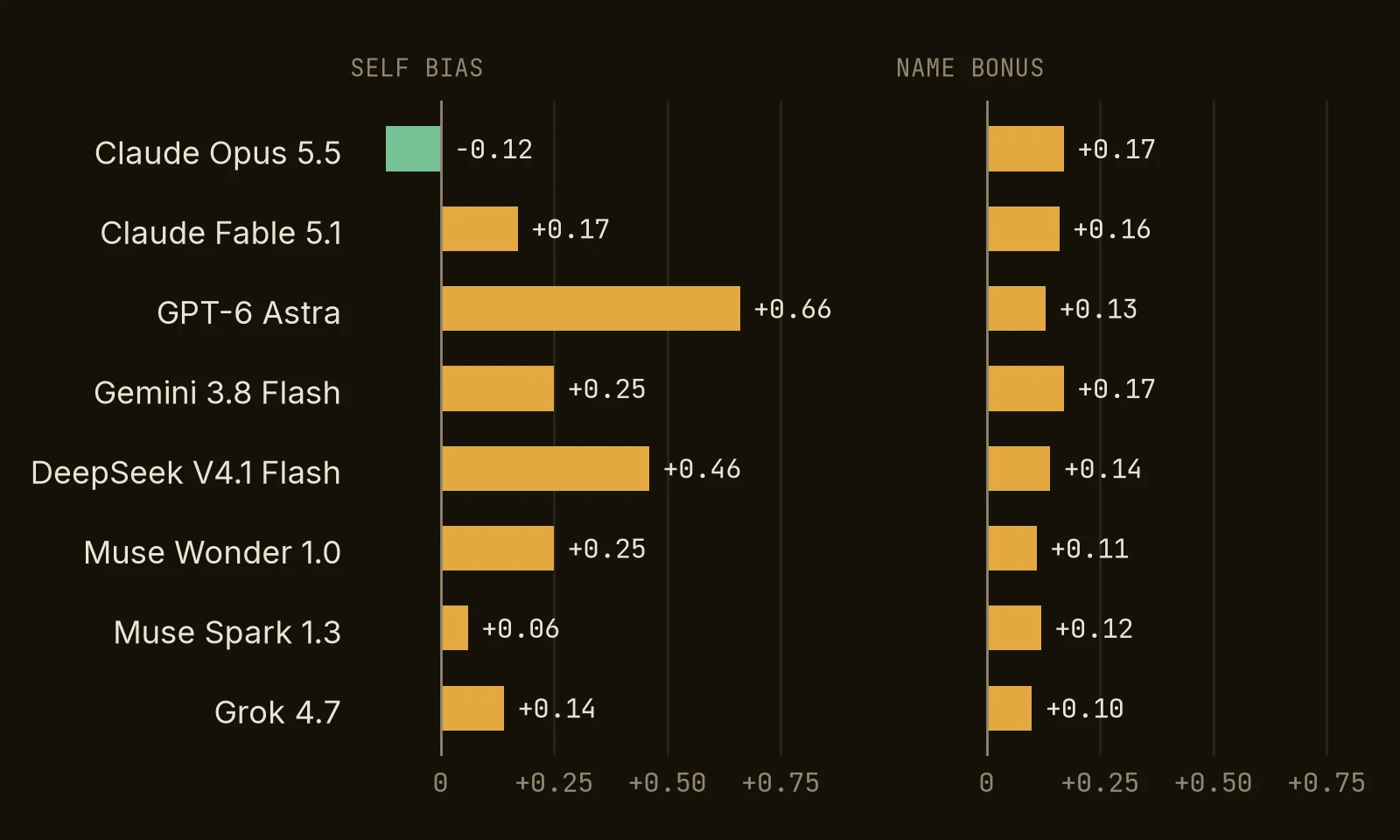
Name bonus. All eight models scored higher once judges could see model names, by 0.10 to 0.17 points. The answers and the judges were the same. Only the label changed.
First-slot bonus. With names hidden and the order fixed, the answer shown first gained 0.13 points over its peer score, exactly as it did last week. Every other position lost between 0.06 and 0.18.
The toughest grader won again
Claude Opus 5.5 was the harshest judge on the panel, with an average grade of 7.52, and it finished first. DeepSeek V4.1 Flash and Muse Wonder 1.0 were the most generous judges (8.29 each) and finished fifth and sixth. Last week showed the same pattern, with Opus at 7.50.
Judges vs. judged
How generously each model graded others, against the peer score it received.
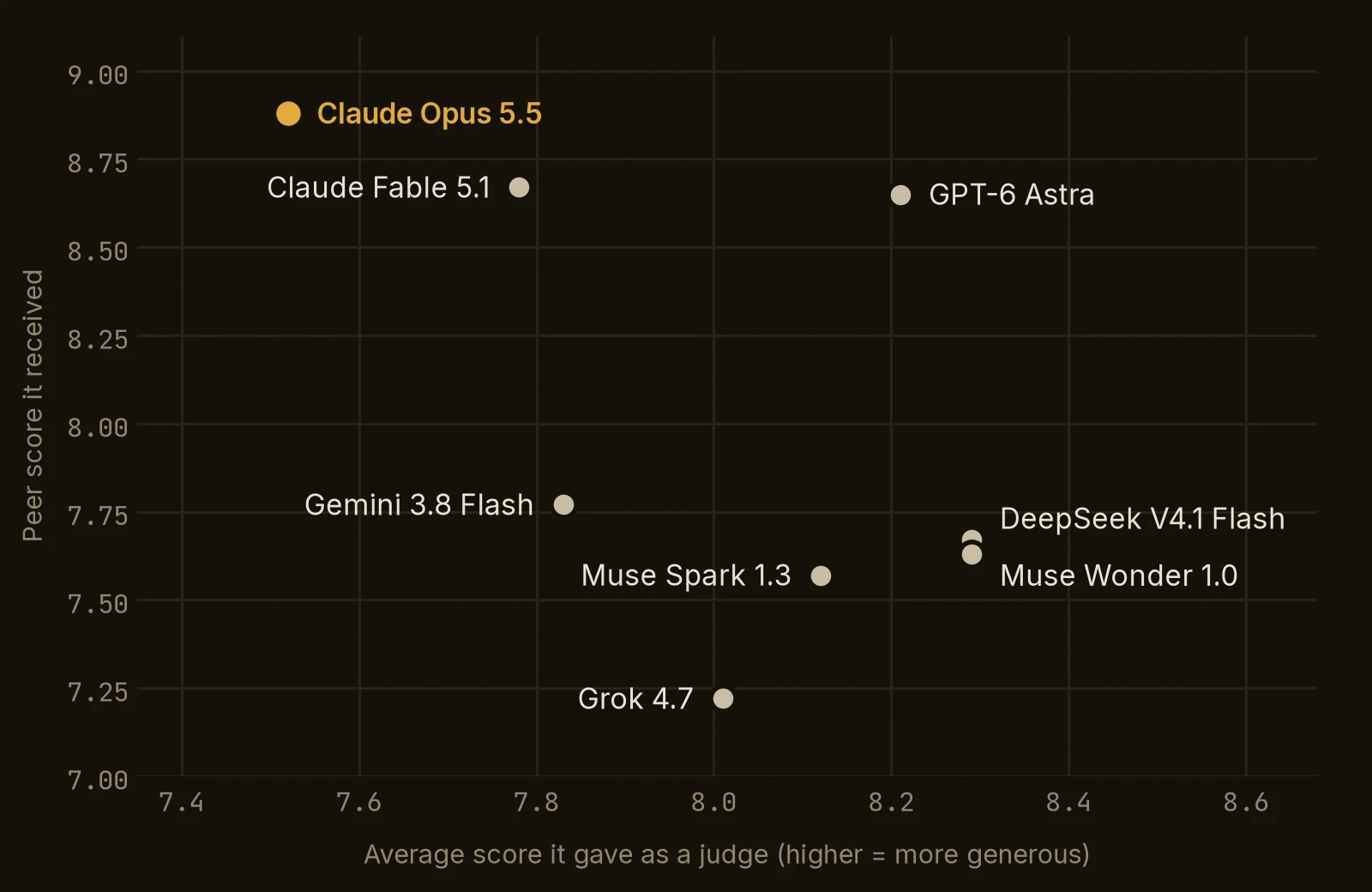
The two Claudes again graded more alike than any other pair of judges (r = 0.85, down from 0.89). The least alike were GPT-6 Astra and Claude Fable 5.1 (r = 0.49). On a judging panel, two models from the same lab count as roughly one opinion.
Home advantage flipped
Do models do better on questions they wrote themselves? Last week, Grok 4.7 did significantly worse on its own questions (−0.64 points). This week it did significantly better (+0.53, p < 0.001), the largest home advantage in the run.
Claude Fable 5.1 went the other way. It scored 0.59 points lower on its own questions, which were also the hardest set in the run (an average of 7.68). Across all eight models, the average home advantage was −0.03 points. An effect that changes sign in a week isn’t a trait of the model. It’s a reason to run the evaluation more than once.
The best model wasn’t the slow one
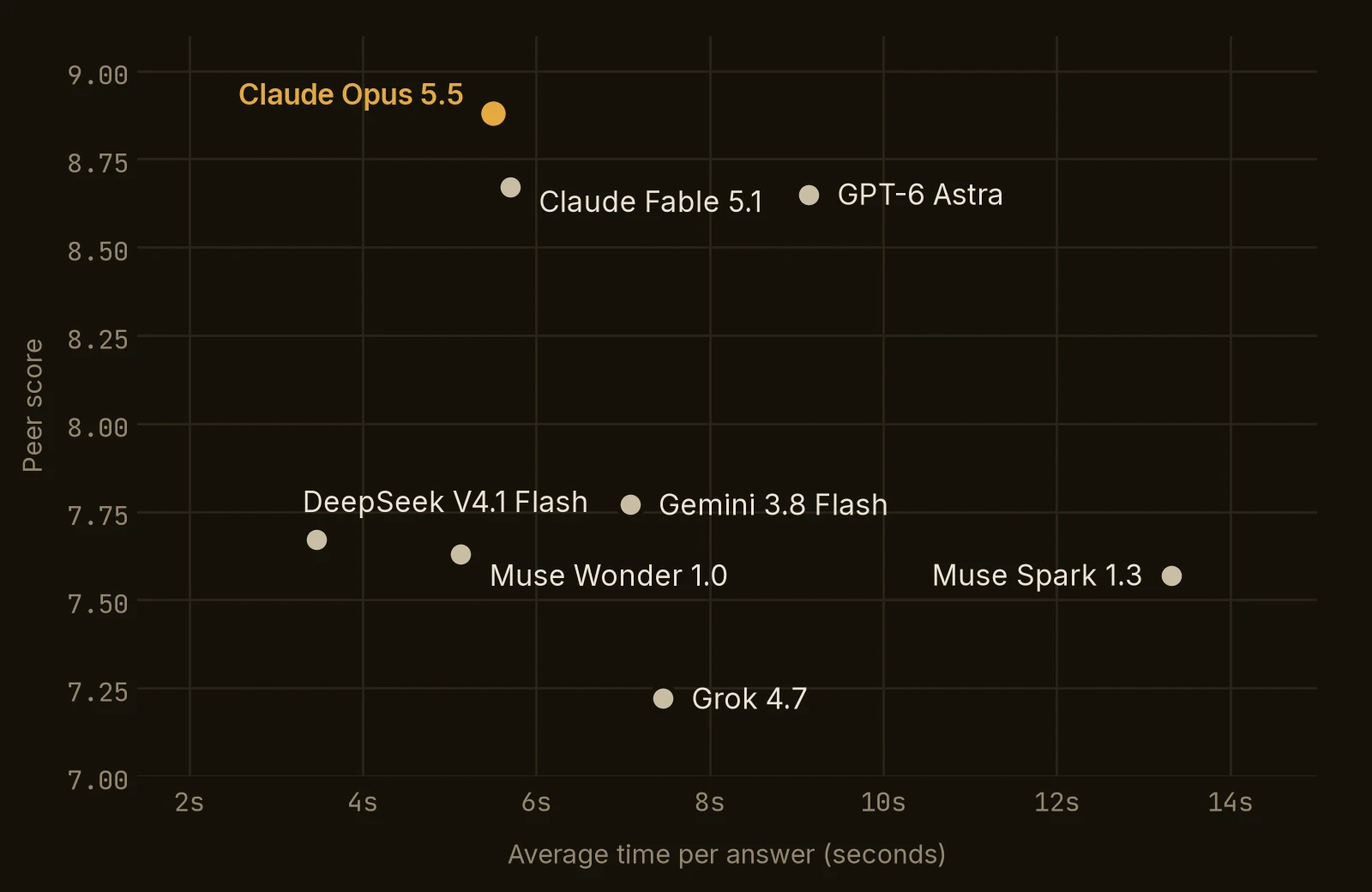
Opus 5.5 answered in 5.50 seconds on average, faster than five of the other seven models. DeepSeek V4.1 Flash was the fastest at 3.47 seconds. Muse Spark 1.3 was the slowest at 13.32 seconds, more than twice as long as Opus for a lower score. Its sibling, Muse Wonder 1.0, answered in 5.13 seconds.
Quality vs. speed
Peer score against average time per answer.
Grading took longer than answering. Opus was also the fastest judge, at 9.17 seconds per evaluation. Grok 4.7 took 59.89 seconds per evaluation and was the only judge to miss one (199 of 200 completed).
If you use AI to grade AI
Two runs in a row point to the same practical rules:
- Run it more than once. The top three held, but the middle reshuffled and one model’s home advantage changed sign in a week. A single run is a sample, not a verdict.
- Ground the judge, not just the answerer. If answers get search and judges don’t, current-events scores measure the judges’ memory.
- Hide names and shuffle the order. The name bonus and the first-slot bonus showed up in both runs.
- Mix labs on the panel. Two Claudes agree at r = 0.85. Count them as one vote.
- Pick per task. GPT-6 Astra led creative and practical work, Opus 5.5 led factual and reasoning, and DeepSeek V4.1 Flash was fastest.
The leaderboard moved in a week and will move again. That’s why at Caura we build to stay model-agnostic: your agents should be able to switch to whichever model is best for the job without losing what they’ve learned.
Swap the model. Keep the memory.
Caura is governed, shared memory for agent fleets on any LLM. Change models whenever the leaderboard does, and what your agents have learned stays with them.
Data: PeerRank run oct-13-26. 8 models, 200 questions (25 per model, 40 per category), 11,137 peer scores, 33,411 pairwise Elo matches. Answers to current-events questions were grounded with web search; grading was not. Self-ratings are excluded from peer scores. Previous run: AIs Have Egos (October 7, 2026). Methodology: PeerRank, arXiv:2602.02589.